
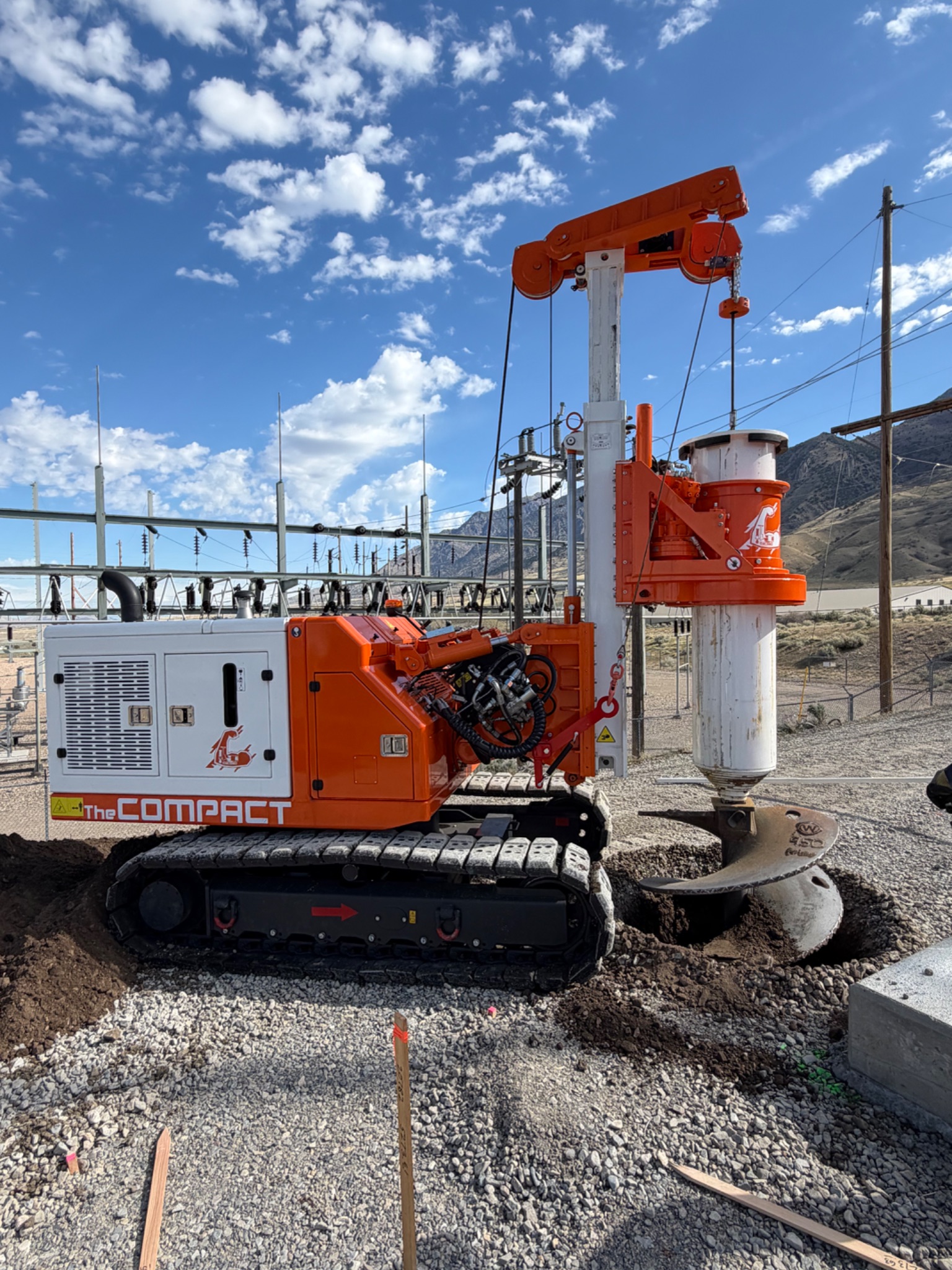
Matching the drilling method to the project
Drilling a transmission tower foundation is nothing like working on an open lot. The foundation design must drive the drilling method. Before selecting equipment, it’s important for contractors to consider the following:
- Required shaft or pile diameter and depth
- Soil and rock conditions
- Need for temporary or permanent casing
- Groundwater conditions
- Available access and working platform
- Overhead and lateral clearance
- Required torque and crowd force
- Spoil management
- Concrete placement requirements
- Mobility between foundation locations
Choosing the wrong drill rig or mast configuration on a site like this puts a crew and a multi-million-dollar machine within arcing distance of a live power line.
This guide covers the drill rig types and pre-drilling protocols that keep transmission foundation work productive and compliant. Keep reading to learn more.
In this guide
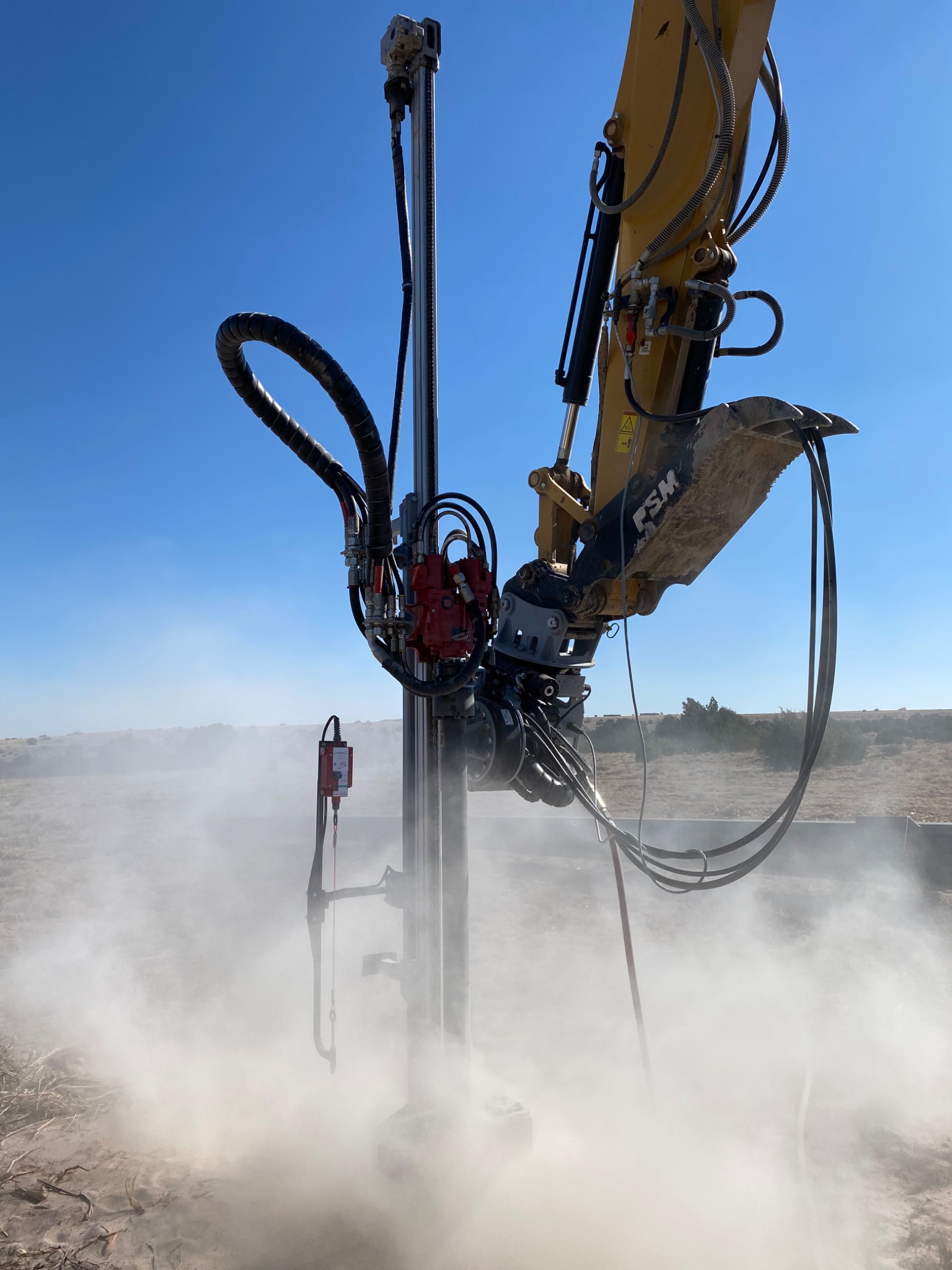
Foundation drilling equipment for tower and substation sites
Most drilled shaft work in the U.S. relies on rotary drilling machines, and the way the machine is mounted directly affects its performance on a transmission right-of-way.
Crawler-mounted drill rigs are the most common choice for remote or rough-terrain sites because the mast is a fixed part of the machine, and the crawler undercarriage moves easily across unimproved ground.
Excavator-mounted drill rigs offer another advantage specific to transmission work. The drill’s compact mast, or feed, is carried on the excavator’s arm rather than on a tall, full-height mast. That lets it reach tower footings with limited overhead clearance or tight side access.
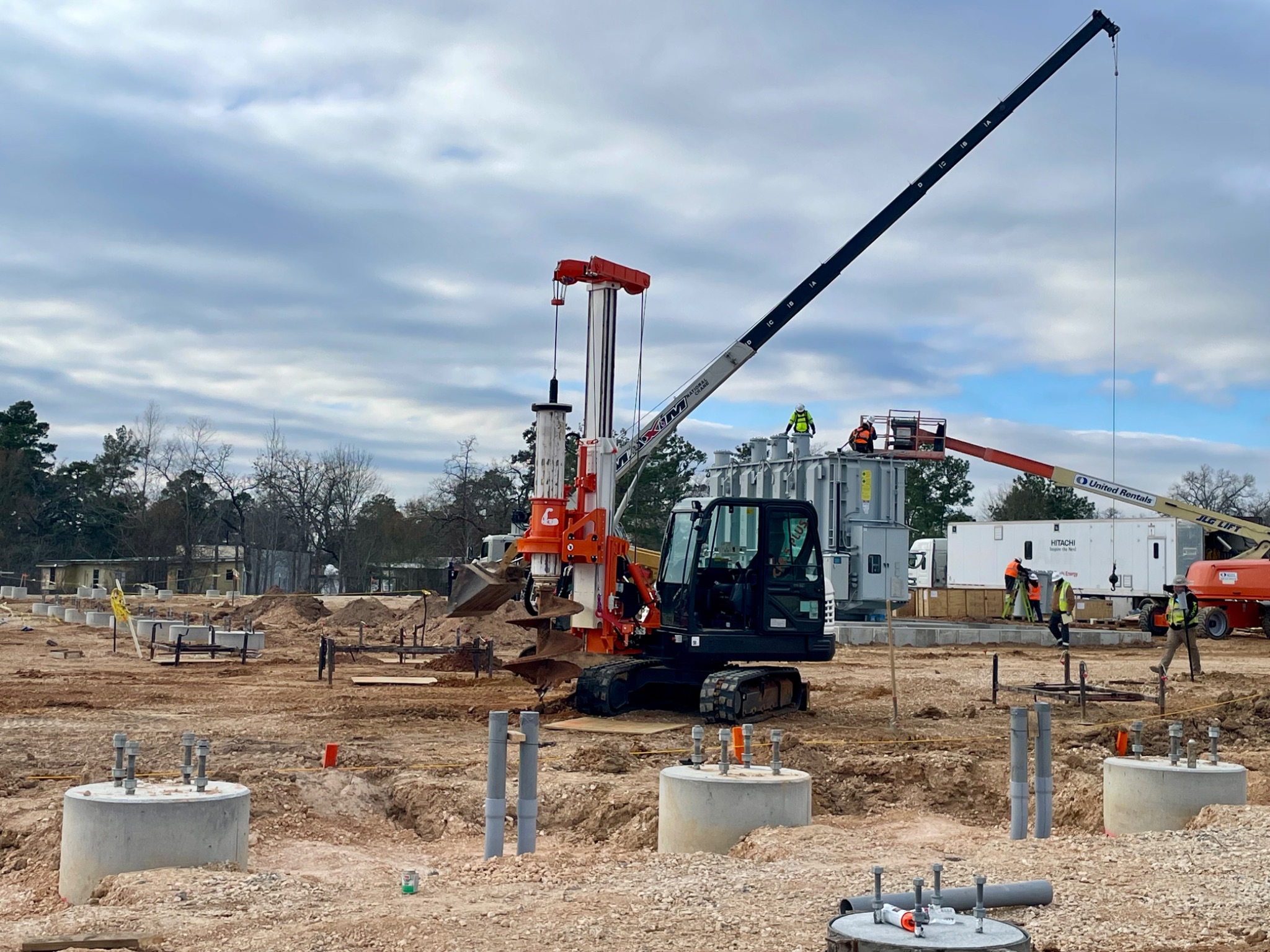
Low headroom masts: drilling under and near live lines
Low-headroom masts allow drilling beneath a fixed overhead obstruction without sacrificing drilling depth and can be used for bridges, tunnels, buildings, industrial facilities, and other applications with restricted height.
Purpose-built compact drilling rigs, excavator-mounted drilling attachments, and low-headroom mast configurations provide solutions for foundation drilling projects with restricted overhead clearance.
Depending on the machine and configuration, these systems can achieve substantial drilling depths while operating within reduced working heights. Some rotary drilling rigs also offer convertible mast configurations, allowing contractors to switch between low-headroom and conventional drilling setups.
Actual drilling depths, diameters, and operating heights vary by equipment model, tooling, and ground conditions.
In a transmission project, this restricted-clearance setup makes it possible to drill a shaft directly beneath a conductor span once the line has been de-energized and cleared. Productivity is reduced compared to a full-height mast, but it’s the only way to safely complete that footing without a line outage lasting the entire job.
Essential clearance rules near overhead power lines
Working near energized overhead power lines requires careful planning and strict adherence to applicable OSHA regulations and utility safety requirements.
OSHA clearance requirements vary depending on the type of equipment, the work being performed, and the voltage of the overhead lines. Under OSHA’s crane and derrick standard (29 CFR 1926.1408), minimum clearance distances established in Table A include:
- 10 feet for lines up to 50 kV
- 15 feet for lines over 50 kV up to 200 kV
- 20 feet for lines over 200 kV up to 350 kV
- Greater distances for higher-voltage lines
These distances are subject to the requirements and protective measures specified in the applicable OSHA standard. Dedicated foundation drilling rigs are excluded from OSHA’s crane and derrick standard under 29 CFR 1926.1400(c)(11). However, the Association of Drilled Shaft Contractors (ADSC) recommends applying comparable power-line clearance distances and safety precautions to dedicated drilling rigs as an industry best practice.
Before positioning or operating foundation drilling equipment, contractors should verify overhead line voltages with the utility owner, establish appropriate clearance distances, and develop a site-specific safety plan.
Compact drilling rigs and low-headroom mast configurations can help contractors operate in restricted spaces, but they do not reduce the required electrical clearances. The entire operating envelope, including the mast, kelly bar, auger, casing, suspended loads, and equipment movement, must be considered when planning drilling operations near power lines.
ADSC’s Large Foundation Drill Rig Reference Manual emphasizes maintaining safe working distances from energized power lines and accounting for changes in ground elevation that could reduce overhead clearance. Warning flags, markers, or protective coverings do not automatically authorize reduced clearance distances.
Pre-drilling safety checklist
To prevent devastating accidents, ADSC recommends that site supervisors run a strict pre-work walkthrough before any equipment is set up near overhead lines:
- Walk the perimeter. Physically map horizontal and vertical distances from the drill location to the nearest utility structures. Don’t rely on plan drawings alone.
- Assign a dedicated spotter. One trained person’s only job is to watch mast clearance during setup, drilling, and mast lowering.
- Engineer the ground platform. Confirm the pad or mats can handle the drill rig’s bearing pressure so the mast can’t lean or settle toward adjacent lines.
- Confirm de-energization in writing. If the plan calls for reduced clearance, get visual confirmation that the line is grounded on-site. Don’t take a phone call as proof.
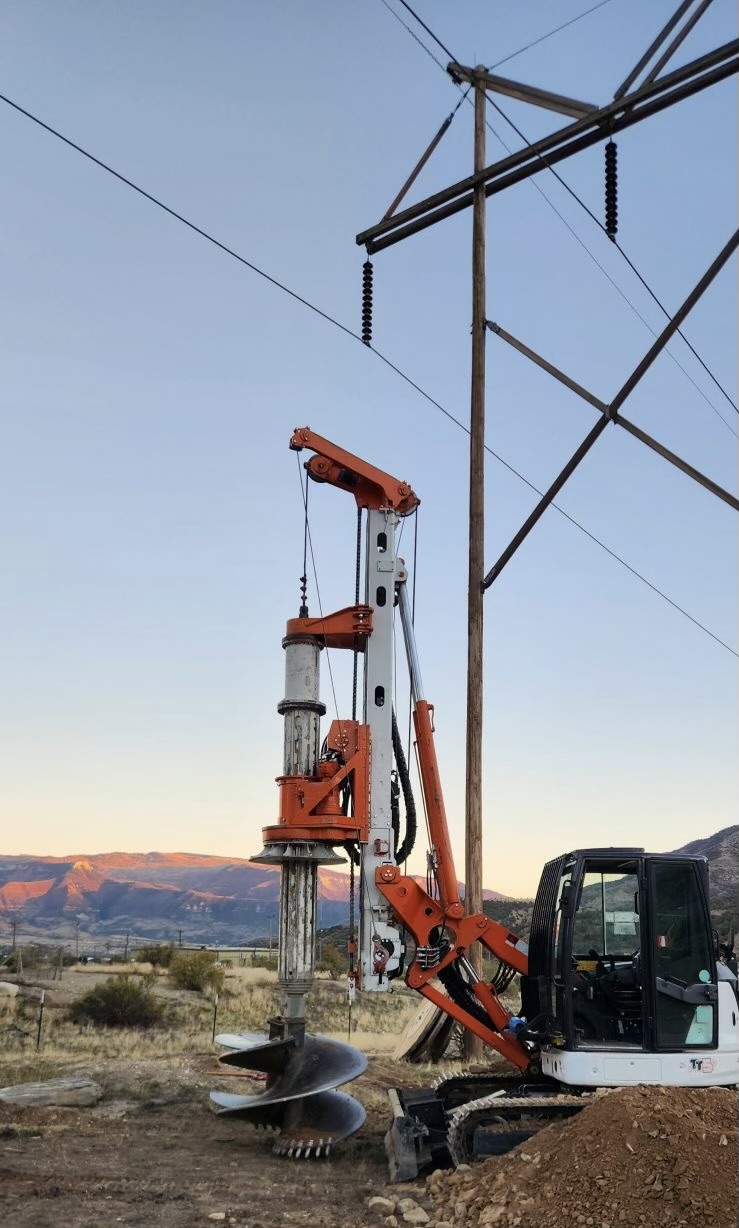
How to safeguard against power line hazards
Foundation drilling equipment must maintain safe clearance from energized overhead power lines throughout all phases of operation. This includes the drill mast, kelly bar, augers, casing, lifting equipment, and other components. While direct contact is highly dangerous, electricity can also arc across an air gap when equipment gets too close to an energized conductor.
Before positioning a drilling rig, contractors should identify overhead electrical hazards, verify line voltages with the utility provider, establish the applicable minimum clearance distances, and conduct a site-specific safety assessment. Work-zone planning must account for the equipment’s full operating range, including mast raising and lowering, drilling, casing installation, and equipment movement.
Where required, trained spotters, warning barriers, and other approved safety measures must be used to help prevent equipment from encroaching on established clearance distances. A spotter does not replace minimum clearance requirements or other required safeguards.
Compact drilling rigs and low-headroom configurations can help contractors operate in restricted-access environments, but smaller equipment does not reduce the required electrical clearance. If safe distances cannot be maintained, operations must stop until the hazard is addressed in coordination with the utility provider and in accordance with applicable OSHA regulations.
De-energized power lines must never be assumed safe. The utility owner or operator must confirm the line’s status, and applicable grounding and protective requirements must be satisfied before reduced-clearance operations are considered. Work must not resume until the site supervisor has verified that the required safety procedures are in place.
Common mistakes to avoid
- Assuming insulated covers, warning flags, or line markers automatically permit reduced clearance distances
- Assuming a booted or flagged line means reduced clearance is allowed
- Estimating approach distance from drawings instead of a physical walkthrough
- Running a full-size mast where a compact, low-profile drill is required
- Skipping the dedicated spotter because “the operator can see fine”
- Setting up on an unverified pad without confirming the bearing capacity
- Estimating electrical clearance distances from drawing without verifying actual site conditions
FAQ
Q: What’s the minimum clearance for foundation drilling equipment near power lines?
According to ADSC-published drilled shaft safety standards, minimum clearance distances from energized overhead power lines are 10 feet for voltages up to 50 kV, 15 feet for voltages over 50 kV through 200 kV, and 20 feet for voltages over 200 kV through 350 kV. Higher voltages require greater clearance distances.
Contractors should verify the line voltage with the utility provider and establish site-specific safety procedures before drilling. If the required clearance cannot be maintained, work must not begin until the electrical hazard has been properly addressed.
Q: How low can low headroom masts actually drill?
Depending on the equipment and configuration, some compact low-headroom drilling rigs can operate with overhead clearances as low as 10 feet while achieving drilling depths of 70 to 90 feet.
Larger, reconfigurable foundation drilling rigs can also be adapted for restricted overhead clearance while maintaining the capability to drill large-diameter piles. Actual clearance requirements and drilling depths vary by machine, tooling, ground conditions, and drilling method.
Q: Does de-energizing a line remove the need for clearance distances?
Not automatically. Power lines must be treated as energized until the utility owner or operator confirms they have been de-energized and properly grounded. Under OSHA’s crane and derrick standards, lines must be visibly grounded at the worksite before crews can rely on de-energization to work within standard clearance distances. Contractors must coordinate with the utility and follow all applicable safety requirements before proceeding.
Contact Western Equipment Solutions today
Western Equipment Solutions supplies and supports the foundation drilling equipment transmission contractors rely on for restricted-access work, from low headroom rigs and masts to the casing tools and wear parts that keep them running through a multi-tower job.
Our lineup includes Soilmec, Marini, and Tescar, plus sales, rental, and field-service backed by a veteran-owned team across the U.S. and Western Canada.
If you’re working a transmission right-of-way with tight clearances or restricted access, contact Western Equipment Solutions to discuss matching the right rig and mast configuration to your job before mobilization.
Disclaimer
For Informational Purposes Only
The information provided in this article is intended for general educational and informational purposes only. Equipment specifications, drilling capabilities, applications, and operating conditions may vary depending on the equipment configuration, ground conditions, project requirements, and site-specific circumstances.
Western Equipment Solutions does not provide engineering, electrical safety, or jobsite safety consulting services. References to OSHA regulations, minimum approach distances, and safety practices are provided for general awareness and should not be considered a substitute for applicable regulations, manufacturer guidelines, site-specific safety plans, or guidance from qualified professionals.
Contractors and equipment operators are responsible for evaluating job site conditions, selecting appropriate equipment, and ensuring compliance with all applicable federal, state, provincial, and local regulations.
Western Equipment Solutions assumes no responsibility for equipment selection, operating procedures, or job site decisions made based on the information contained in this article.